Share The Love
Recent Posts
Canva Got You Started. Here Is Where It Stops.
Canva is one of the best things to happen to small business owners. It is cheap, it is fast, and it lets you make a flyer at midnight without calling anyone. For a brand-new business watching every dollar, that is exactly the right tool. So this is not a post about how Canva is bad, because it is not.
Instead, it is a post about a moment. At some point a growing business outgrows the do-it-yourself stage. The signs are easy to miss, too, until they start to cost you. So if you are wondering whether that moment has arrived, here is how a Golden Isles graphic designer would tell.

You Cannot Actually Own Your Logo
Here is the one thing most owners never hear until it is too late. When you build a logo from Canva’s templates and stock graphics, you cannot trademark it. Canva gives you a license to use that content, but only a non-exclusive one. In plain terms, other businesses can use the very same elements. So the law will not let you claim the mark as uniquely yours.
There is a narrow exception. You can trademark a logo only if you build it from basic shapes, lines, and fonts, or from artwork you drew and uploaded yourself. However, most people do not make a Canva logo that way. Most start from a template, and anyone else can grab that same template. So the day you want to protect your name, a template logo will not get you there. And every growing brand eventually wants that protection. A DIY logo you cannot own is one of the more expensive branding mistakes a small business makes. A Golden Isles graphic designer draws you something original instead, and it is yours to keep.
You Need Files Canva Will Not Give You
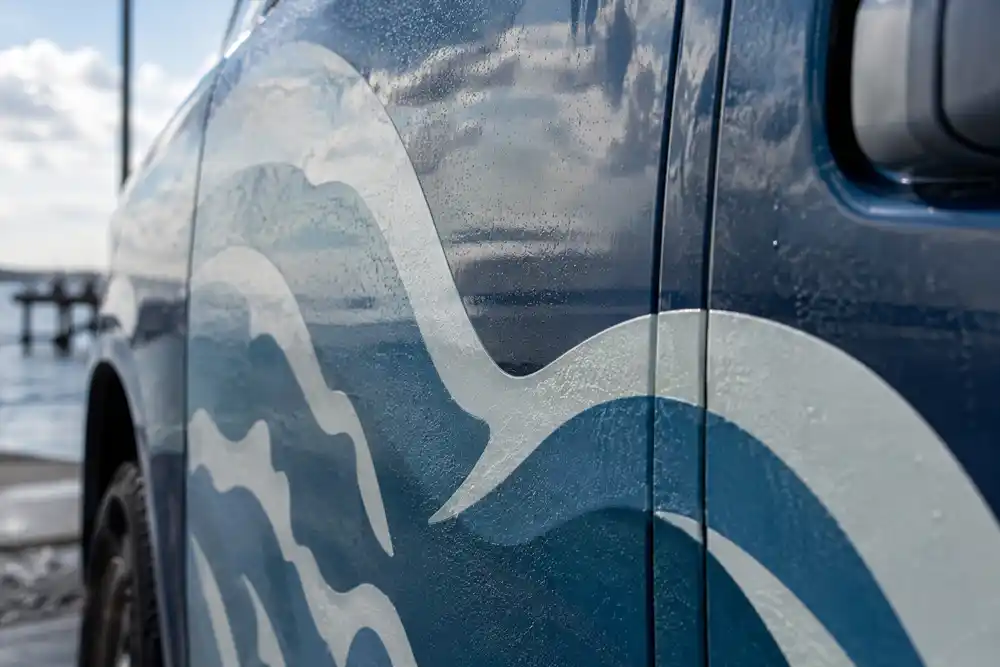
Your logo is going to end up in places a screen-sized image cannot handle. A vehicle wrap. A carved sign. An embroidered shirt. A banner at a festival. All of those need a vector file, which stays razor-sharp at any size, from a business card to the side of a truck.
Canva’s free plan does not export vector files at all. Even on a paid plan, an export still falls short of true, layered vector art. A designer draws that kind of logo to scale from the start. When we branded A.P.E.S., a Brunswick electrician, the mark had to read clean on a phone screen and on the side of a van. That only works when someone draws the artwork that way on purpose. So the day someone asks for a “vector version” you cannot produce is the day you have outgrown the tool.
Everything Starts to Look Like Everyone Else
Millions of people use Canva’s templates, and on this coast that really shows. Scroll the local feeds. You will see the same beach script, the same sunset gradient, the same three layouts, over and over. So when your brand uses the same templates as the shop two doors down, you blend in. And you blend in at the exact moment you want to stand out.
A real brand, by contrast, looks unmistakably yours: your own type, your own color choices, a logic a template cannot copy. Do you want an edge that is genuinely hard to imitate? Then it helps to understand tactile branding and the small details that make a brand feel considered rather than assembled.
You Are Rebuilding Your Brand From Scratch Every Time
On the free plan you get one very basic brand kit. You cannot even save your own logo into it or upload a custom font. As a result, every new flyer becomes a small act of reinvention. You hunt for the right blue again. You eyeball the logo size again. And nothing quite matches the last thing you made.
A proper brand, on the other hand, comes with a simple system: the exact colors, the fonts, the spacing, and the rules that keep them consistent. Once a Golden Isles graphic designer sets that up, everything you make afterward agrees with everything else. Ironically, that is also what makes your own DIY work better, because now you are filling in a template that is actually yours.

The Quiet Cost of Your Own Time
There is a quieter cost too. The hours you spend nudging text boxes at eleven at night are hours away from running your business. For a while that trade is worth it, because money is tighter than time. As you grow, though, that balance flips. Eventually your time becomes the scarce thing, and handing the brand to someone who does this all day turns into the cheaper choice, not the expensive one.
So When Is Canva Still the Right Call?
Plenty of the time, honestly. For social posts, internal documents, quick promos, and everyday graphics, Canva is excellent, and you should keep using it. The smart setup is not Canva or a designer. Instead, it is both. A Golden Isles graphic designer builds the foundation you cannot make yourself: the logo you own, the vector files, the brand kit. Then you use Canva on top of it, inside those guardrails. That way you get consistency and speed at the same time.
Not Sure If You Have Outgrown It?
Here is a simple rule of thumb. If your brand is about to go somewhere permanent, such as a sign, a wrap, a trademark, or a storefront, hire a designer to build the foundation first. If you are still testing and posting, Canva is fine for now.
So if you think you are at that turning point, take a look at how a Golden Isles graphic designer approaches branding for small coastal businesses. You can also see what a right-sized branding project actually costs. You work directly with the designer, start to finish, and you can still open Canva on Monday morning.